
Best Deal Websites for Indie Apps
Many indie founders turn to deal websites expecting growth. What they actually get is attention.
Deal platforms are exceptionally good at compressing visibility into a short window. They can put an app in front of thousands of users in days, sometimes hours. For founders without an audience, budget, or brand recognition, that kind of exposure feels like progress—and in the moment, it often is. Sign-ups increase. Traffic spikes. Feedback arrives quickly.
But research and real-world founder data consistently show the same pattern: attention alone does not translate into sustainable growth.
Studies in customer acquisition and promotion research have consistently shown that users acquired through deep discounts or short-term promotions tend to exhibit lower long-term retention and lifetime value than users acquired through non-promotional, intent-driven channels. In particular, Lewis (2006) finds that customers acquired via promotional incentives demonstrate lower repeat-purchase behavior and reduced customer asset value over time.
Founder discussions on platforms like Indie Hackers echo this pattern: deal-driven launches often generate activity without durability—spikes without compounding momentum.
This mismatch isn’t accidental. Deal websites are designed to optimize for immediacy, not longevity. They reward novelty, urgency, and price incentives. That makes them powerful accelerators—but poor foundations. When founders treat deal platforms as a growth strategy instead of a tactical tool, outcomes feel unpredictable. Support load rises. Margins shrink. Churn increases once the deal ends. Growth stalls, even though the product itself may be strong.
In a market where thousands of new indie apps and AI-powered tools launch every year, these trade-offs matter more than ever. The cost of attention hasn’t dropped, but the tolerance for misalignment has. Users move faster, filter harder, and disengage quickly when expectations don’t match reality.
This article reframes deal websites for what they really are: attention accelerators that only work when aligned with the right stage, expectations, and follow-up channels. Instead of ranking platforms blindly, it explains how deal sites behave, when they help, when they hurt, and how indie founders can use them without sacrificing long-term momentum, pricing power, or product focus.
The Deal Site Promise: Attention Disguised as Growth

When Deal Sites Help — and When They Hurt
Deal websites aren’t inherently good or bad. They’re conditional.
They help when the role they play matches the product and the stage. They hurt when expectations, business models, and user psychology pull in opposite directions. This distinction becomes especially important for subscription-based apps.
For many subscription-first founders, deal platforms feel like a paradox.
The launch brings attention. Users sign up quickly. Activity spikes. But beneath the surface, something feels off. Users are engaged at first, yet hesitant later. Renewal conversations feel tense. Pricing questions dominate feedback. Churn appears earlier than expected.
The problem isn’t the subscription model. It’s the mismatch between how deal users arrive and how subscription businesses grow.
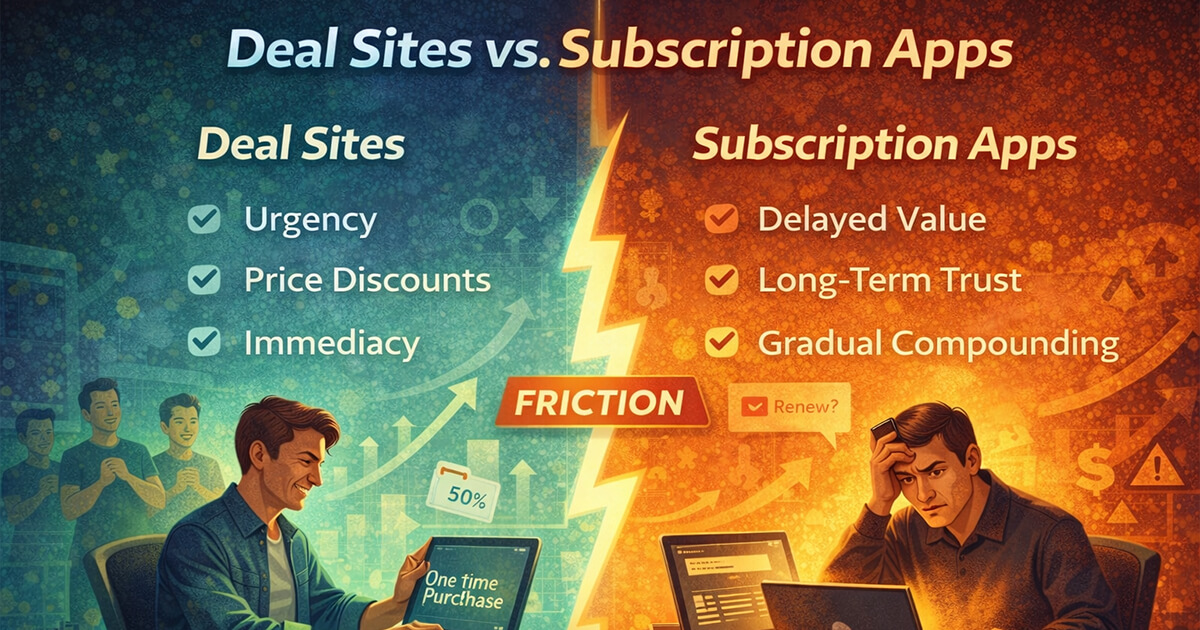
Deal platforms attract users who are motivated by immediacy—price drops, urgency, limited-time offers. Subscription businesses, on the other hand, depend on delayed value. Trust builds over time. Outcomes compound gradually. The user doesn’t fully experience the benefit on day one.
When those two forces collide, friction appears.
Users arrive anchored to price, not outcome. The initial discount becomes the reference point. When renewal time comes, the conversation shifts from value to cost—even if the product genuinely delivers. Resistance feels personal, not rational.
This is why many subscription-first products struggle on deal platforms—not because deals don’t work, but because they’re treated as endpoints instead of entry points.
The solution isn’t avoidance. It’s sequencing. For subscription-based apps, deal platforms work best when they follow a simple roadmap:
First, the deal introduces the product—not the business model. The goal is exposure and experience, not conversion to long-term revenue on day one.
Second, the onboarding shifts focus from price to outcome. Early users need to understand what changes in their workflow, not what they paid.
Third, a follow-up path reinforces value after the deal. This usually happens through discovery channels, education, email, or continued visibility—places where users can re-encounter the product when the problem becomes more relevant.
Finally, the subscription is positioned as continuity, not escalation. Renewal isn’t framed as “paying more,” but as maintaining access to something that’s already proven useful.
When this sequence is respected, deal platforms can still play a meaningful role for subscription apps. They act as controlled entry points into a longer relationship—not pressure points that force premature monetization.
Deal sites hurt when this roadmap is skipped. They backfire when founders expect a single launch to produce durable growth, when pricing is introduced before value is understood, or when there’s no system to re-engage users after the attention fades. In those cases, deals don’t just fail to help—they actively distort user expectations.
This is why outcomes vary so widely across founder stories. The same platform can validate one subscription app and undermine another. The difference isn’t luck. It’s alignment—between product model, user psychology, and promotion sequence.
Deal platforms don’t decide success for subscription businesses. They simply reveal whether the path from attention to retention has been designed—or left to chance.
Best Deal Websites for Indie Apps
Once deal platforms are understood for what they are—attention accelerators with trade-offs—the question changes. It’s no longer “Which deal site is best?” but “Which deal site fits my product, stage, and goals right now?”
Different platforms optimize for different outcomes. Some deliver intense, short-term visibility. Others favor ongoing discovery. Some attract highly price-sensitive users. Others surface products to audiences already in evaluation mode.
Below are the most relevant deal websites indie founders use today—and how they actually behave in practice.
AppDovo — Discovery-First Deal Platform
AppDovo is built for founders who want deal-driven attention without treating deals as one-time events.
Unlike launch-only platforms where visibility fades as soon as the promotion ends, AppDovo is designed around ongoing discovery. Apps remain visible on the platform beyond their active discount period, allowing users to discover both current deals and past offers as they browse. This creates continuity that most deal platforms simply don’t provide.
This matters because discovery doesn’t happen in a single moment.
Many users don’t convert the first time they see an app. They compare. They come back later. They revisit tools when the problem becomes more relevant. By keeping apps accessible even after a deal expires, AppDovo supports this slower, more realistic discovery behavior—especially for indie products that aren’t impulse purchases.
AppDovo’s audience is also intentionally deal-aware.
With 20,000+ subscribers who actively opt in to discovering discounted apps, software deals, and indie tools, users arrive with clear expectations. They’re not casual browsers. They’re actively looking for value. For founders, this reduces the friction that often comes with introducing discounts to the wrong audience.
Key characteristics:
- Active and past deals remain discoverable on the platform
- Repeated exposure instead of single-day spikes
- Audience expects discounts, not perfection
- Founder-friendly access, currently free to list
AppDovo works best for indie apps that are ready for attention and want a path forward after the deal ends—especially when paired with retention or discovery channels like email, content, or ongoing product updates.
It isn’t positioned as a replacement for SEO, communities, or owned audiences. Instead, AppDovo functions as a bridge between attention and discovery, helping founders turn initial exposure into repeat visibility rather than starting from zero after every launch.
AppSumo — High-Impact Attention Platform
AppSumo remains the most recognizable deal platform in the indie ecosystem.
Its strength is scale. A successful AppSumo launch can introduce an app to tens of thousands of users in a very short time. For early-stage products, this can validate demand quickly and generate meaningful revenue upfront.
The trade-offs are well known:
- Heavy emphasis on discounts or lifetime deals
- Highly price-sensitive users
- High support expectations
- Limited long-term discoverability after the deal ends
AppSumo works best for:
- MVP validation
- One-time or bounded-value tools
- Founders prepared for support and feedback volume
It’s powerful—but rarely sustainable on its own.
Indie App Santa — Seasonal Indie Exposure
Indie App Santa operates on a time-bound, seasonal model, typically around holidays.
This creates urgency and novelty, which can be useful for indie developers looking for:
- Short-term visibility
- Community-driven exposure
- Lightweight promotion without long commitments
Because exposure is limited to specific periods, it’s best treated as a supplementary channel, not a core growth driver.
AppRaven
AppRaven is focused primarily on mobile apps, particularly iOS.
It attracts users who actively track app discounts and price drops, making it well-suited for:
- Paid mobile apps
- Utility and productivity apps
- One-time purchase models
While it doesn’t offer massive spikes, it delivers high-intent deal-seekers who are already accustomed to paying for apps.
TouchArcade
TouchArcade is niche, but powerful—especially for games.
Its audience is highly engaged, opinionated, and informed. For indie game developers, exposure here often carries more credibility than generic deal platforms.
Best for:
- Indie games
- iOS-focused launches
- Community-driven discovery
Not suitable for most SaaS products, but highly effective within its niche.
StackSocial — Large Deal Marketplace
StackSocial sits closer to traditional deal aggregation.
It offers:
- Broad exposure
- Cross-promotion across multiple deal channels
- Access to mainstream deal-hunting audiences
However, like many large marketplaces, competition is high and differentiation is harder. Best used as an attention layer, not a retention strategy.
| Platform | Primary Strength | Discovery Behavior | Best For | Main Trade-Off |
|---|---|---|---|---|
| AppDovo | Low-cost access + ongoing deal discovery | Active and past deals remain visible, enabling repeat discovery | Indie apps post-launch seeking sustained visibility | Deal-focused audience, discount expected |
| AppSumo | Massive launch attention | Discovery concentrated during active deal window | MVPs, LTD tools, rapid validation | Low LTV, high support load |
| Indie App Santa | Seasonal exposure | Visibility limited to campaign period | Indie visibility bursts | Timing constraints |
| AppRaven | High-intent mobile users | Price-drop driven discovery over time | Paid mobile apps | Mobile-only focus |
| TouchArcade | Niche credibility | Editorial and community-driven discovery | Indie games | Category-specific |
| StackSocial | Broad deal reach | Aggregated listings with limited continuity | Deal amplification | High competition |
| Newsletters & Communities | Trust and relevance | One-off or periodic mentions | Early traction, feedback | Limited scale |
How to Choose the Right Deal Platform
Choosing a deal platform isn’t about finding the biggest name or the loudest launch. It’s about alignment.
Most founders get this decision wrong because they ask the wrong question. They ask, “Which platform will give me the most exposure?” The better question is, “What kind of exposure does my app actually need right now—and what happens after it?”
Three factors matter more than any platform ranking.
Your App’s Stage and Growth Goals
Early-stage apps benefit from learning, not scale. At this stage, deal platforms are useful for validating interest, testing messaging, and understanding how strangers interpret the product. Large spikes can help—but only if you’re prepared to process feedback and adjust quickly.
Later-stage apps need continuity. Visibility that disappears after a week creates pressure to relaunch constantly. Platforms that support ongoing discovery—where users can encounter the app again—tend to work better once the product and positioning are clearer.
Before choosing a platform, be honest about your goal:
- Are you validating demand?
- Are you trying to build awareness?
- Or are you looking for steady, repeat discovery?
- Each goal points to a different kind of deal environment.
Pricing Model and User Expectations
Deal platforms don’t just distribute apps. They shape how users think about price.
If your product relies on subscriptions or long-term value, the deal should act as an introduction—not a permanent anchor. That means planning how users experience value before renewal decisions appear. Platforms that allow ongoing visibility or re-engagement make this easier.
For one-time purchases, utilities, or clearly bounded tools, deal-driven pricing often feels natural. In these cases, the deal is the value proposition, and friction is lower.
The mistake isn’t offering discounts. It’s offering discounts without considering how they reset expectations.
What Happens After the Deal Ends
This is the most overlooked question—and the most important one. If the answer is “nothing,” the deal is doing too much work on its own.
Successful founders treat deal platforms as entry points, not destinations. They know where users will encounter the product next—through search, content, email, communities, or continued visibility on the platform itself. That follow-up is what turns attention into traction.
Where an app appears after the deal ends often matters more than the deal itself. Choosing the right listing environments for ongoing discovery is a separate decision entirely, which we explore in Where to List Your Indie App for Maximum Exposure.
Before committing to any deal platform, ask:
- Will users be able to find my app again?
- Is there a clear next touchpoint?
- Do I have the capacity to retain users once they arrive?
Deal platforms don’t create growth paths. They expose whether one exists.
When the platform, product stage, pricing model, and follow-up channels are aligned, deals can accelerate progress without distorting the business. When they’re not, even the best platforms underperform.
Choosing the right deal platform isn’t about minimizing risk. It’s about placing the risk where it makes sense—and making sure attention has somewhere to go once it arrives.
Final Thought: Use Deal Sites Deliberately
Deal websites aren’t shortcuts to growth. They’re levers.
Pulled at the right moment, they can accelerate learning, visibility, and momentum. Pulled without context, they amplify the wrong signals—price sensitivity, churn, and short-lived spikes that don’t carry forward.
The difference isn’t the platform. It’s intent.
Founders who succeed with deal sites know exactly what role the deal is meant to play—and what comes next after the attention fades. They don’t expect a single promotion to build a business. They use it to move the business forward.
In a crowded indie app landscape, deal platforms still matter. But only when they’re used as part of a broader system—one where attention feeds discovery, discovery feeds retention, and growth doesn’t reset after every launch.
That’s how deal sites stop being a gamble—and start becoming a tool.


