
Top Platforms to Promote Indie Apps in 2026
In 2026, building an app is easier than ever. Getting discovered is the hard part.
This guide breaks down the best platforms to promote indie apps—by stage, not hype—using a simple promotion system you can actually follow. Because most indie developers don’t fail at building products. They fail at being seen.
The app is live. Onboarding works. Features are solid. Early users sign up, a few reviews roll in, and everything feels promising—until it doesn’t. Momentum fades. Installs flatten. Sign-ups slow down. Growth quietly stalls. In 2026, this isn’t an edge case. It’s the norm.
AI tools have dramatically lowered the barrier to building software. Solo founders can now design interfaces, write backend code, test features, and ship production-ready SaaS products or mobile apps in weeks instead of months. As a result, development speed is no longer the main bottleneck for indie teams.
Promotion is.
Despite the explosion of new apps, the cost of attention hasn’t dropped. Paid ads remain expensive, influencer marketing is unpredictable, and organic reach continues to shrink across most platforms. Across founder communities like Indie Hackers and startup programs such as Stripe Atlas, the same pattern keeps emerging: customer acquisition and distribution remain the hardest problems for early-stage founders.
That’s why choosing where and when to promote your app matters more than ever in 2026.
Promotion today isn’t about finding one “best” platform. It’s about understanding timing, user intent, and how different channels work together across the lifecycle of an indie app. The platforms you choose don’t just bring users—they shape expectations, influence retention, and quietly determine how your app grows.
That’s exactly what this guide is designed to help you navigate.
If you’re still deciding whether AppSumo is right for you, we covered that in detail here: Best AppSumo Alternatives for Indie Developers (2026)
Key Takeaways
- Promotion is harder than building in 2026
- No single platform works at every stage
- Timing matters more than tools
- Platforms shape user behavior
- Stacked promotion beats one-off launches
Promotion in 2026 Is a Process, Not a Platform
Most founders ask the wrong question when it comes to promotion. They ask, “Which platform should I use?” It’s an understandable question. There are dozens of platforms, marketplaces, communities, and deal sites all promising visibility. But it’s the wrong starting point. The better question is, “What stage am I in right now?”
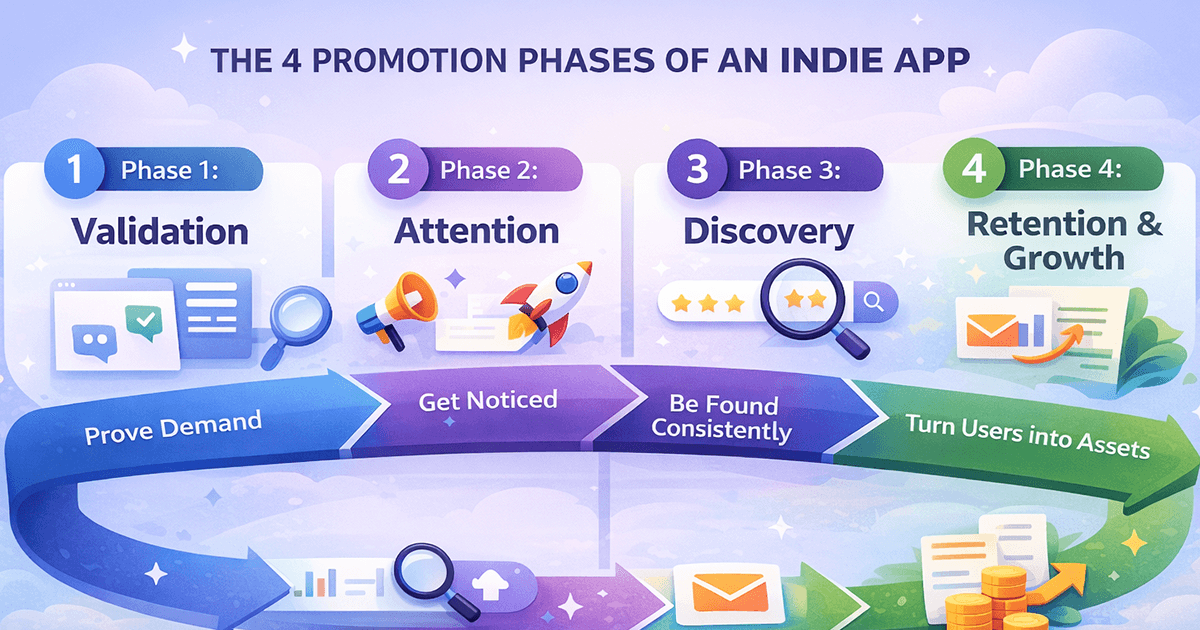
The 4 Promotion Phases of an Indie App (Explained)
Every successful indie app goes through the same four promotion phases. Not because founders carefully plan each step—but because growth follows patterns.
Whether you’re building a SaaS product, a mobile app, or a developer tool, the path from idea to sustainable growth tends to unfold in a predictable way. The stages may overlap, and timelines may vary, but the sequence rarely changes.
Skipping a phase doesn’t save time. It usually creates problems later—problems that are harder and more expensive to fix. Many indie developers jump straight to promotion platforms, launch deals, or paid ads without confirming one critical thing first.
Does anyone actually want this?
Without that answer, every promotion decision becomes guesswork. Traffic feels random. Feedback feels conflicting. And growth becomes difficult to explain or repeat. That’s where Phase 1 begins.
Phase 1: Validation
Goal: Prove that people actually want the app.
At this stage, the product is rarely perfect—and it doesn’t need to be. The core idea usually works, but the experience is still rough. Features evolve quickly, assumptions get challenged, and pricing is often provisional. Many founders change it more than once. This isn’t a red flag. It’s normal.
In fact, most successful indie SaaS products, mobile apps, and developer tools launched with incomplete feature sets. What mattered wasn’t polish—it was signal. Paul Graham famously summarized this idea in early Y Combinator advice :
“Make something people want.”
Not something perfect. Not something scalable. Just something people genuinely care about. Promotion in Phase 1 is not about scale. It’s about learning. Instead of asking, “How do I get more users?” the better question is, “Do the right users care?”
At this stage, you’re looking for clarity—not growth. That clarity comes from signals like:
- Users returning without reminders.
- Specific feedback tied to real use cases.
- Evidence that the problem feels painful enough to solve.
Founder communities, early-access groups, and small, engaged audiences tend to work best here. These environments allow direct conversations, follow-up questions, and context around why users behave the way they do. Large platforms usually fail at this stage. Not because they’re ineffective—but because they introduce too much noise.
When hundreds or thousands of users arrive at once—especially from deal platforms or large marketplaces—it becomes difficult to separate meaningful insight from surface-level reactions. Support requests spike. Feature demands conflict. Early signals get buried under volume. This is why many experienced founders validate quietly before scaling publicly.
Phase 1 isn’t about growth. It’s about clarity. And without clarity, every promotion decision that follows becomes guesswork.
Phase 2: Attention
Goal: Get noticed.
Once you know the app has value, the next challenge is visibility. At this point, the question is no longer “Does this work?” but “How do people find it?”
Phase 2 is about creating initial momentum. It’s the moment when an indie app steps out of quiet validation and into public awareness. This phase typically focuses on three things: Momentum, awareness, and first real exposure.
Attention platforms exist for exactly this purpose. They compress visibility into a short window and deliver users quickly. For indie developers without an audience, this can feel like a breakthrough. Data shared by startup accelerators and founder communities consistently shows that early visibility increases confidence, speeds up iteration, and helps founders understand how strangers—not early supporters—react to their product.
But attention has a limit. Attention platforms work fast—but briefly. They bring users quickly, but attention fades unless something follows. This is where many founders stop. That’s the mistake.
Research from product-led growth teams and SaaS benchmarks shows that traffic spikes without follow-up rarely translate into retention. Users arrive, explore briefly, and leave—often without returning. To understand why, it helps to look at how Phase 2 actually behaves in practice.
| What Attention Delivers | What It Does Not Deliver |
|---|---|
| Short-term traffic spikes | Long-term discoverability |
| Initial awareness | Consistent inbound demand |
| Early social proof | Strong retention by default |
| Fast feedback at scale | Deep user understanding |
Phase 3: Discovery
Goal: Be found consistently.
Discovery is where growth becomes sustainable. Unlike attention-driven promotion, discovery doesn’t rely on spikes. It relies on relevance. Instead of short bursts of traffic, discovery focuses on:
- Search intent.
- Contextual visibility.
- Ongoing, repeatable traffic.
This is where users find your app when they need it—not when you shout the loudest. For most indie developers, this phase determines whether an app plateaus
or quietly compounds over time. Search-driven content, curated discovery platforms, and comparison pages all play a role here. They don’t deliver instant results—but they build momentum that lasts. To understand why this matters, consider a common pattern seen across indie SaaS and developer tools.
A Real-World Indie Case Pattern
An indie developer launches a small productivity SaaS. The app gains early traction through a launch campaign and a short-term promotion. Traffic spikes. Sign-ups increase. Then, within weeks, activity drops. Instead of repeating launches, the founder shifts focus. They publish a handful of targeted articles: use-case guides, comparison posts, and problem-specific content based on real questions users asked during earlier phases.
At first, nothing happens. After a few months, organic traffic begins to appear. A few sign-ups arrive each week—from users actively searching for the problem the app solves. Six months later, those same pages are still bringing users. Support requests are more focused. Retention improves. Pricing resistance decreases.
This pattern shows up repeatedly in founder stories shared on Indie Hackers, SEO case studies from Ahrefs, Backlinko and Zizta and long-term growth breakdowns from SaaS operators.
The takeaway is consistent: discovery compounds because intent compounds. Users who arrive through discovery channels already know what they’re looking for. They’re comparing options, evaluating fit, and solving a real problem. That context leads to higher-quality users and more predictable growth. This is why most long-term indie success lives in Phase 3. Attention gets you noticed. Discovery keeps you alive.
Phase 4: Retention & Growth
Goal: Turn users into assets.
By the time an indie app reaches this phase, the biggest risk is no longer visibility—it’s dependence. Dependence on platforms, algorithms, and external
sources of traffic that can change without warning.
Phase 4 is where promotion shifts inward. Instead of asking how to acquire the next user, founders focus on keeping the users they already have and building relationships that compound over time.
At this stage, growth is driven less by exposure and more by trust. Users return because they want to, not because they were pushed by a platform. Retention efforts in this phase typically revolve around a small set of owned channels:
- Email lists that allow direct communication without intermediaries
- Communities where users feel invested in the product’s direction
- Product updates that reinforce momentum and progress
- Trust built through consistent support and clear communication
These channels may not scale as quickly as ads or launch platforms, but they scale more safely. They reduce dependency on third parties and give founders control over how and when they engage their audience.
Research shared by SaaS operators and product-led growth teams consistently shows that retained users behave differently from acquired ones. They convert more reliably, require less support over time, and are more likely to recommend the product to others. Retention also stabilizes revenue. Subscription renewals, upgrades, and repeat usage create predictability—something short-term traffic spikes rarely deliver.
This is what allows indie apps to survive platform changes, algorithm shifts, and market saturation. When discovery slows or a channel disappears, retained users provide continuity. Phase 4 doesn’t replace earlier promotion phases. It protects them. And for indie developers building long-term businesses in a crowded 2026 ecosystem, that protection often makes the difference between steady growth and constant reset.
Top Platforms to Promote Indie Apps — By Phase
Best Platforms for Validation (Phase 1)
In the validation phase, smaller is better.
The goal here is not traffic or growth. It’s learning. You want environments where conversations happen naturally, feedback is honest, and users understand the realities of indie products that are still evolving. Founder communities such as Indie Hackers, niche Reddit subcommunities, private Slack or Discord groups, and early-access programs work well at this stage. These spaces allow direct interaction with users and provide important context behind feedback—why someone struggled, what they expected, and what problem they were actually trying to solve.
For many founders, the earliest validation doesn’t even start on public platforms. It starts closer to home. Friends, professional peers, former colleagues, and trusted contacts can be valuable early testers—especially when they resemble the intended audience. Small, private groups on Facebook, WhatsApp, Telegram, or even Skype often outperform larger communities because they allow deeper, more candid conversations.
These channels work best when founders ask problem-focused questions rather than seeking encouragement. The goal isn’t approval. It’s understanding how people react, where they hesitate, and whether they would use the product again without being reminded.
Early-access platforms and invite-only betas also perform better than large marketplaces during validation. They attract users who are curious and willing to experiment, rather than users who expect a finished, polished product with full support and documentation.
Large platforms usually fail at this stage because volume hides insight. When too many users arrive at once, feedback becomes noisy. Feature requests conflict. Support messages spike. And it becomes difficult to tell which signals actually matter. At this stage, growth metrics matter far less than learning speed. A handful of engaged users—people who ask questions, return voluntarily, and challenge assumptions—can be far more valuable than hundreds of passive sign-ups.
Best Platforms for Attention (Phase 2)
Attention platforms exist for one primary reason: visibility.
Once you know the app has value, the challenge becomes getting noticed beyond your immediate circle. This is where deal platforms, discount-driven exposure, and launch-focused marketplaces come into play.
For indie developers without an audience, this can feel like a breakthrough. Traffic spikes. Sign-ups increase. Feedback arrives faster. But attention has a shelf life. Without a follow-up channel—such as discovery or retention—traffic fades just as quickly as it arrives. This is where many founders stop, assuming the platform alone will sustain growth. That’s the mistake.
Attention works best when it feeds into the next phase. Without that transition, founders are forced to relaunch repeatedly, chasing spikes instead of building momentum.
Best Platforms for Discovery (Phase 3)
Discovery platforms are built for relevance, not hype.
This phase focuses on being found consistently by users who are actively looking for a solution. Search engines, content platforms, and curated discovery sites play the central role here. SEO-driven blog content, use-case pages, and comparison articles help capture search intent. Curated app discovery platforms surface tools based on category and problem, rather than launch timing or discounts alone.
Unlike attention platforms, discovery compounds. A single well-positioned article or listing can continue driving traffic for months or even years. This pattern is repeatedly documented in SEO case studies published by Ahrefs and Backlinko, and long-term founder stories shared on Indie Hackers.
In 2026, when thousands of new apps and AI-powered tools launch every year, being findable matters more than being loud. Users arriving through discovery channels tend to have higher intent, clearer expectations, and better long-term retention. This is where sustainable indie growth usually begins.
Best Platforms for Retention (Phase 4)
Retention happens mostly off platforms. By this stage, growth depends less on where users come from and more on whether they stay. Acquisition brings users in, but retention determines whether the app becomes a business or fades into noise. This is where owned channels become critical—email lists, communities, and direct communication with users.
Email newsletters allow founders to communicate without relying on algorithms or third-party platforms. They create a direct line to users for updates, improvements, and long-term messaging. Communities—whether hosted on Discord, Slack, or private forums—add another layer by creating emotional investment and a sense of shared ownership around the product.
But retention isn’t only about broadcasting updates. It’s about listening.
User reviews, comments, and direct feedback play a central role in this phase. Reviews on platforms, replies to emails, community discussions, and support messages reveal how real users experience the product over time—not how founders hope it works.
For indie developers, these signals are especially valuable because they come from users who chose to stay. Their comments highlight friction points, missing features, unclear flows, and unmet needs that aren’t always visible through analytics alone. Many successful indie apps evolve primarily through this feedback loop, improving incrementally based on real usage rather than assumptions.
Research shared by product-led growth teams and SaaS operators consistently shows that apps that actively respond to user feedback tend to retain users longer and generate more referrals. When users see their comments acknowledged—or their suggestions implemented—it builds trust and increases long-term engagement.
These retention channels don’t scale fast. But they scale safely.
They reduce reliance on any single acquisition platform and create stability when external channels shift due to algorithm changes, policy updates, or market saturation. Over time, retained users become repeat customers, advocates, and a source of ongoing product insight.
This is why most indie apps that survive long-term invest in retention early—even if lightly. Email lists, communities, and user feedback systems don’t just protect revenue. They guide product direction, stabilize growth, and turn real users into the strongest asset an indie developer can have.
Phase-to-Platform Comparison (2026)
| Promotion Phase | Primary Goal | Best-Fit Platforms & Channels | What Success Looks Like | Common Mistake |
|---|---|---|---|---|
| Phase 1: Validation | Prove real demand | Indie Hackers, niche Reddit communities, Discord or Slack groups, early-access betas, invite-only pilots |
Honest feedback, repeat usage, clear problem–solution fit |
Chasing scale before learning |
| Phase 2: Attention | Get noticed | Product Hunt, AppSumo, deal platforms, launch communities, niche deal sites |
Visibility spikes, broad market reaction, fast feedback at scale |
Treating a spike as a growth strategy |
| Phase 3: Discovery | Be found consistently | SEO, content marketing, comparison articles, curated discovery platforms, evergreen listings |
Compounding traffic, steady sign-ups, high-intent users |
Expecting instant SEO results |
| Phase 4: Retention & Growth | Turn users into assets | Email newsletters, communities, product updates, lifecycle messaging, direct relationships |
Repeat usage, renewals, upgrades, referrals, stable revenue |
Relying on a single platform |
Where AppDovo Fits in the Promotion Lifecycle
AppDovo is designed specifically for Phase 2 (Attention) and Phase 3 (Discovery).
It exists because of a clear reality in 2026: AI made app creation affordable, but app promotion is still not. AppDovo connects indie developers with a 20,000+ subscriber audience of app lovers who actively look for discounted apps, software deals, and new indie products. These users are already in discovery mode—meaning they
are not casual browsers.
That makes AppDovo effective for gaining initial attention through discounts while also supporting ongoing discovery beyond launch day. Unlike one-time launch platforms, it’s built to surface apps repeatedly to users who expect deals and actively seek value.
AppDovo isn’t meant to replace SEO, communities, or owned audiences. It’s meant to fit into a broader system—bridging attention and discovery in a way that’s accessible to solo founders and bootstrapped teams.
If your app is ready for attention and discovery, you can submit it to AppDovo and reach users actively looking for new tools and deals.


