
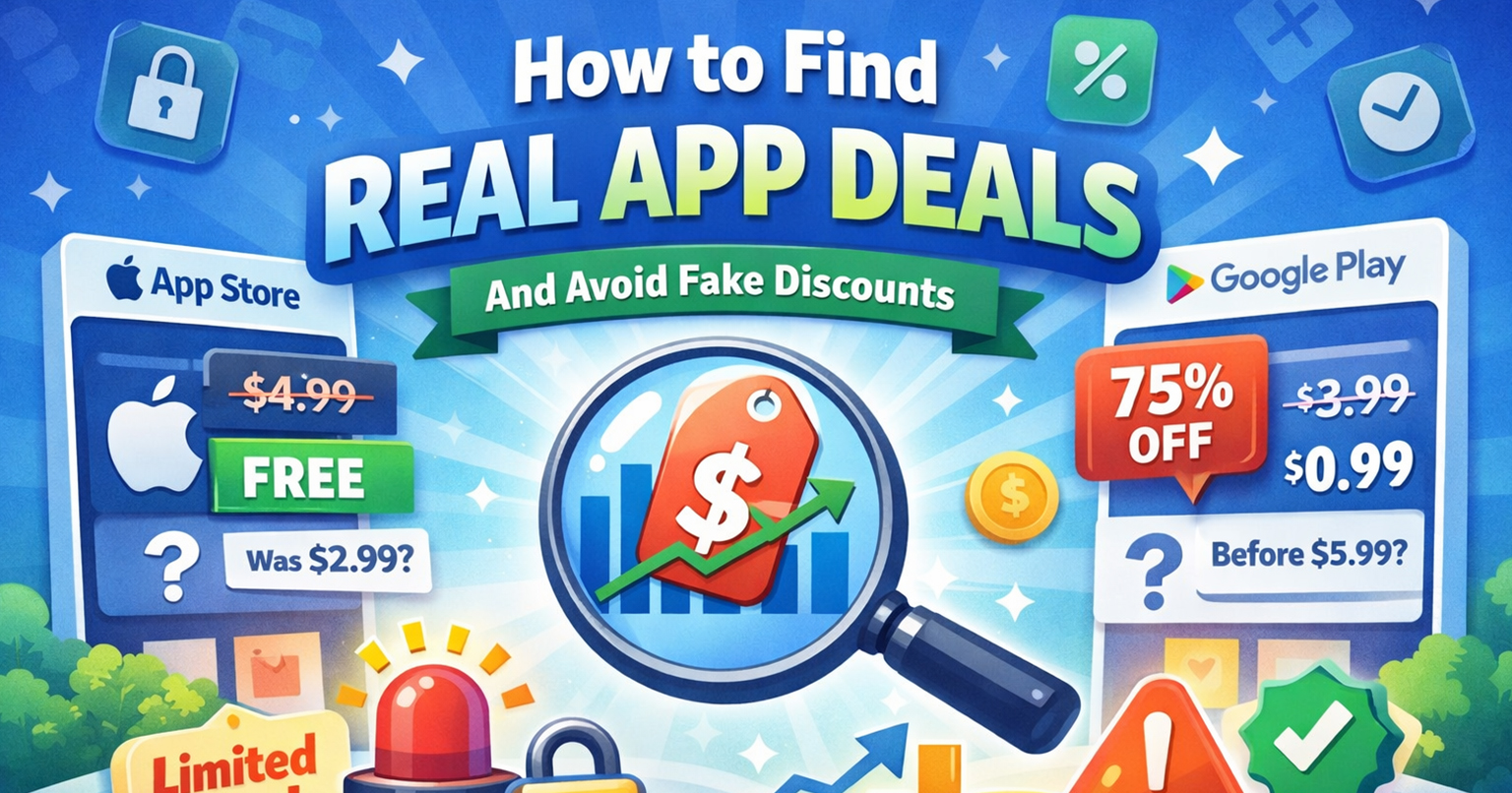
How to Find Real App Deals And Avoid Fake Discounts
Most users discover apps in only two places: the App Store and the Google Play Store.
They are familiar.
They are trusted.
And for everyday browsing, they work well.
The problem starts when users look for real app deals.
Both stores surface discounts. Some apps appear cheaper. Others suddenly go free. But neither store explains what actually changed. Users see a lower price, but not the reason behind it. There is no simple way to tell whether a price drop is temporary, experimental, or something that happens often.
This lack of context affects how people decide. Users hesitate. Or they rush. Many download apps out of fear of missing out rather than confidence. Research published by the European Commission on price reduction transparency shows that consumers are more likely to feel misled when discounts are shown without clear reference prices or historical context. When users cannot verify whether a discount reflects a real reduction, trust in digital marketplaces drops.
Similar conclusions appear in studies by the OECD, which note that unclear pricing signals increase impulsive decisions and post-purchase regret in digital markets, especially where price history is hidden.
App stores were never designed to explain pricing behavior. They show the price now. They rarely show what it was before. And they almost never explain why it changed. As a result, users are left guessing whether a deal is meaningful or just noise.
Finding real app deals should feel simple.
In practice, it rarely is.
Why App Stores Are the Main Source — But the Worst Place to Find Deals
App stores are built for discovery, not transparency.
They are designed by Apple and Google to surface apps that perform well. Popular apps. Trending apps. Apps with strong ratings and engagement. This works well for discovery. It works poorly for pricing clarity.
On the App Store, users see the current price. That’s it. There is no visible price history. No indicator that an app was cheaper yesterday. No signal showing whether an app recently went free or has always been free. When prices change, the store stays silent.
The Google Play Store provides slightly more context. Sometimes a previous price is crossed out. Sometimes a discount percentage is shown. But even here, discovery stops quickly. There is no filter to view all price drops. No way to list apps that recently went free. Users still have to rely on chance.
This isn’t an accident. Pricing decisions are managed through tools like App Store Connect and Google Play Console. These tools are built for developers, not users. They allow price changes, experiments, and regional testing. They do not require public explanations.
From a store’s perspective, this makes sense. App stores prioritize activity. Downloads. Engagement. Rankings. Price changes are just one lever among many. Explaining pricing behavior to users is not part of the system.
For users, however, the result is confusion. A discounted app might look appealing. But without context, it’s impossible to judge value. Is this a rare price drop? A routine promotion? Or just normal pricing behavior repeating itself?
This gap between discovery and transparency is why finding real app deals inside app stores feels so difficult.
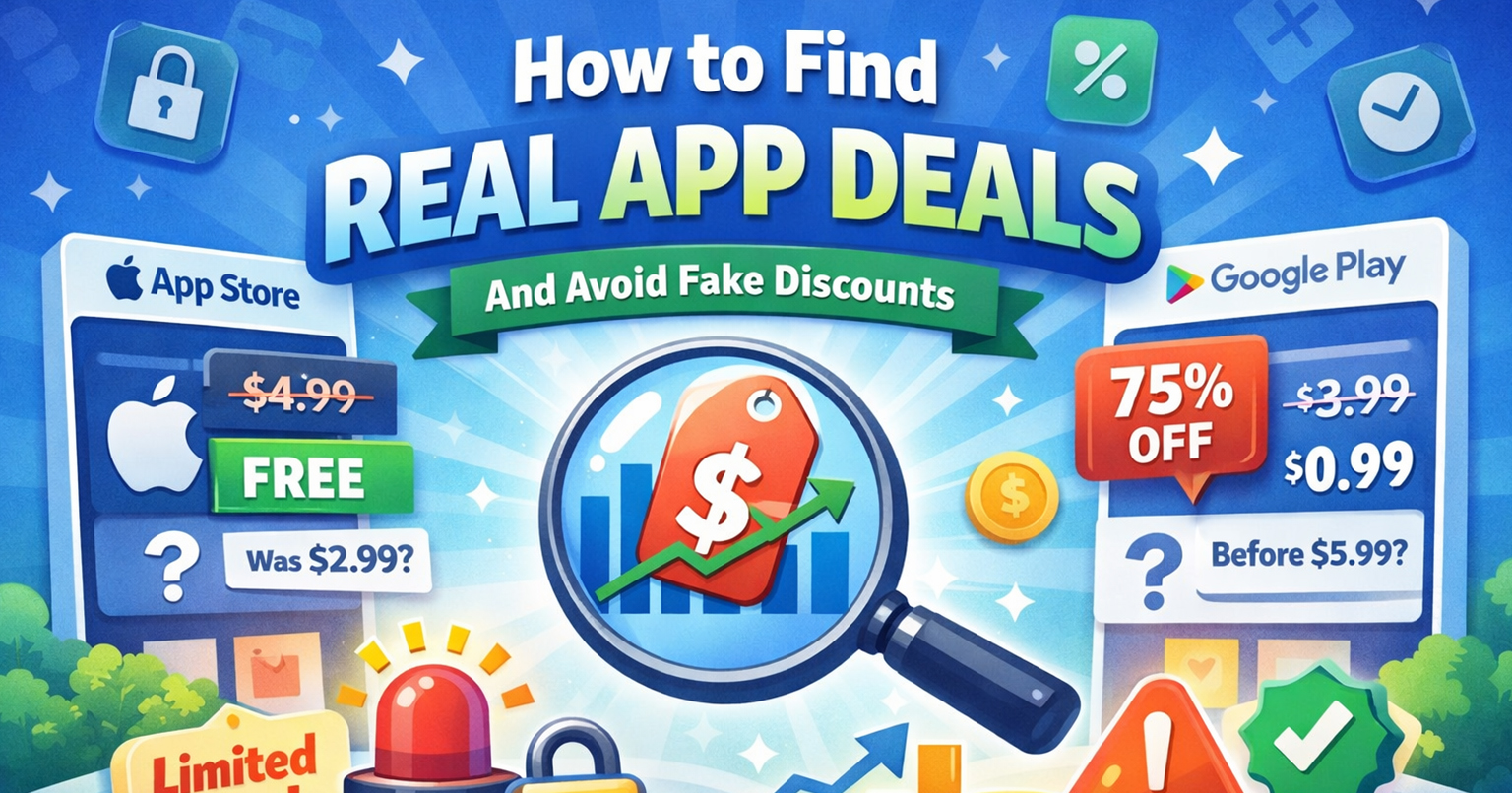
Why the App Store Doesn’t Show Price Drops
The App Store is the main place most users discover apps.
It is familiar.
It is trusted.
And for everyday browsing, it works well.
The problem appears when users try to understand app deals.
The App Store is built by Apple for discovery, not pricing transparency. It is designed to surface apps that perform well. Popular apps. Trending apps. Apps with strong ratings and engagement. This helps users find apps quickly. It does not help them understand how app discounts actually work.
On the App Store, users only see the current price. That’s it. There is no way to check app price history. No indicator showing whether an app was cheaper yesterday. No clear signal explaining if a paid app going free is temporary or permanent. When prices change, the App Store does not explain why.
This makes it difficult to understand app store price drops. Users cannot tell if a discount is rare or routine. They cannot see how often apps go on sale. And they have no reliable way to know if an app deal is real or just normal pricing behavior repeating itself.
From a user’s point of view, every price looks final. Even when it isn’t.
Pricing changes are managed behind the scenes through tools like App Store Connect. These systems are built for developers, not users. They allow price changes, experiments, and regional testing. They do not require developers to explain price drops publicly or show previous prices to users.
From Apple’s perspective, this approach makes sense. The App Store prioritizes downloads, engagement, and rankings. Price changes are just one lever among many. Explaining pricing behavior or discount patterns to users is not part of the design.
For users, however, the result is uncertainty. A discounted app may look appealing. But without context, it’s hard to judge value. Is this app deal worth it? Is it a rare price drop? Or something that happens every few weeks?
This lack of price history and transparency is why finding real app deals on the App Store feels difficult — even though it remains the first place users search.
Why Google Play Shows Discounts — But Doesn’t Help You Find Them
Why Google Play Shows Discounts — But Doesn’t Help You Find Them
The Google Play Store handles pricing differently from other app stores.
When an app is discounted, Google Play often shows a cut price. A previous price may appear crossed out. Sometimes a discount percentage is displayed. This gives users a small hint that a price drop happened. But it still does not solve the real problem of how to find app deals on Google Play.
Seeing a discount is not the same as discovering one.
Cut Prices Without Discovery Filters
Google Play does not provide filters to view all price drops.
There is no way to list all discounted apps in one place.
There is no dedicated section for apps that recently went free.
Users cannot filter by “price drop.”
They cannot browse apps going free today.
They cannot sort apps by recent discounts or temporary price reductions.
This makes it difficult to understand how Google Play price drops actually work.
No Way to See All Price Drops or Free Apps
Because of this, users still have to browse manually. They scroll through categories. They check apps one by one. They rely on timing, luck, or repeated visits. Many real app deals are missed simply because users don’t know where to look.
This also makes it hard to answer common questions users have. How often do Android apps go on sale? When do paid apps go free on Google Play? Will this price drop return next week? Without a way to track price history or view discount patterns, users are left guessing.
Google Play discounts exist. That much is clear. But discovering them at scale is not easy. Users can see individual deals only after they stumble upon them. There is no systematic way to find discounted apps, verify whether an app deal is real, or decide if a price drop is worth acting on.
So while Google Play shows discounts, it does not help users consistently find real app deals. It shows price changes. It does not explain them. And it does not make discovery any easier.
Google Play makes discounts visible.
The App Store hides price changes almost entirely.
But for users, the outcome is the same.
In both cases, there is no simple way to discover all real app deals in one place. No clear way to track price drops over time. And no easy way to know whether a paid app going free is rare or routine. Users can see discounts only after they stumble upon them.
This is why many users eventually look beyond app stores and turn to third-party deal and price-tracking websites — hoping to find the context that app stores don’t provide.
Why Some Paid Apps Go Free for a Short Time
Paid apps do not go free randomly.
In most cases, a temporary price drop is part of a visibility strategy. Developers reduce prices to increase downloads. A short spike in installs can help an app climb store rankings. Better rankings bring more organic traffic later, even after the price goes back up. This is how many app price drops actually work.
This is why users often see paid apps going free for a limited time.
Some apps go free during major updates. New features create interest, and a temporary free period lowers friction. Others go free during launches, relaunches, or seasonal events. Holidays, weekends, and promotional periods are common moments when temporary app discounts appear.
In many cases, these apps return to paid pricing quietly. There is no announcement. No reminder. And no clear signal showing when the price will increase again after the discount ends. From a user’s point of view, the free period simply disappears.
This creates uncertainty. Users don’t know how often apps go on sale. They can’t tell if a paid app going free is a rare opportunity or something that happens every few weeks. They have no easy way to see if the app price drop follows a pattern or if it’s a one-time event.
As a result, users ask the same questions.
Is this app deal worth it?
Should I download now or wait?
Will this price drop come back?
This is why understanding when paid apps go free, how long app deals usually last, and whether prices typically go back up matters when trying to find real app deals instead of acting on urgency alone.
Why Deal Websites Feel Incomplete
Finding real app deals requires context.
A discount alone is not enough.
Users need signals.
They need history.
Knowing how to know if an app deal is real starts with understanding past pricing.
Was the App Paid Before?
This is the first question that matters.
If an app recently switched from paid to free, it often signals a real app deal. In many cases, this means a temporary app discount or a short-term price drop. If an app has always been free, the deal usually has little value.
Without an easy way to check app price history, users struggle here. They can’t tell whether a paid app going free is rare or something that happens often. They also can’t confirm if the app was ever paid at all. This makes it difficult to decide whether an app discount is real or just normal pricing behavior.
Understanding how app price drops work is one of the most reliable ways to judge app value.
Will the Price Likely Go Back Up?
The second question is timing.
Some apps repeat discounts often. They go on sale every few weeks. Others drop their price once and never repeat it. Knowing the difference helps users decide whether to download now or wait.
A real app deal is usually temporary. It is often tied to a clear reason, such as a major update, a launch window, or a promotional event. In these cases, an app price increase after the discount is common.
Without visibility into app discount patterns, users are left guessing. They don’t know how long app deals usually last. They don’t know if the price will increase again tomorrow or stay low for weeks. And they don’t know whether waiting will lead to the same deal later.
This is why checking whether an app was paid before and whether the price is likely to go back up are two of the most important steps when deciding if an app deal is worth downloading.
How to Check If an App Deal Is Worth Downloading
Paid apps do not go free randomly.
In most cases, a temporary price drop is part of a visibility strategy. Developers reduce prices to increase downloads. A short spike in installs can help an app climb store rankings. Better rankings bring more organic traffic later, even after the price goes back up. This is how many app price drops actually work.
This is why users often see paid apps going free for a limited time.
Some apps go free during major updates. New features create interest, and a temporary free period lowers friction. Others go free during launches, relaunches, or seasonal events. Holidays, weekends, and promotional periods are common moments when temporary app discounts appear.
In many cases, these apps return to paid pricing quietly. There is no announcement. No reminder. And no clear signal showing when the price will increase again after the discount ends. From a user’s point of view, the free period simply disappears.
This creates uncertainty. Users don’t know how often apps go on sale. They can’t tell if a paid app going free is a rare opportunity or something that happens every few weeks. They have no easy way to see if the app price drop follows a pattern or if it’s a one-time event.
As a result, users ask the same questions.
Is this app deal worth it?
Should I download now or wait?
Will this price drop come back?
This is why understanding when paid apps go free, how long app deals usually last, and whether prices typically go back up matters when trying to find real app deals instead of acting on urgency alone.
What a Better Way to Discover App Deals Looks Like
A better way to discover app deals focuses on clarity, not urgency.
It starts by looking at price changes across both app platforms, not just one store at a time. Users shouldn’t have to think in terms of iOS deals versus Android deals. They should be able to understand how app price drops work wherever the app lives.
A better approach also provides context instead of pressure. It helps users check app price history, understand whether a paid app going free is temporary, and see if a discount follows a pattern. This makes it easier to decide whether an app deal is real or just another short-lived promotion.
Most importantly, it treats app deals as a discovery problem, not a guessing game. Instead of forcing users to scroll endlessly or rely on timing, a better system helps users find real app deals, understand how long app deals usually last, and decide when to download discounted apps and when to wait.
This is the gap platforms like AppDovo aim to address by bringing cross-platform app deals into one place and adding the context that app stores don’t provide. The goal isn’t urgency. It’s understanding. And that makes all the difference when trying to judge app value.
Final Thoughts
A better way to discover app deals focuses on clarity, not urgency.
It starts by looking at price changes across both app platforms, not just one store at a time. Users shouldn’t have to think in terms of iOS deals versus Android deals. They should be able to understand how app price drops work wherever the app lives.
A better approach also provides context instead of pressure. It helps users check app price history, understand whether a paid app going free is temporary, and see if a discount follows a pattern. This makes it easier to decide whether an app deal is real or just another short-lived promotion.
Most importantly, it treats app deals as a discovery problem, not a guessing game. Instead of forcing users to scroll endlessly or rely on timing, a better system helps users find real app deals, understand how long app deals usually last, and decide when to download discounted apps and when to wait.
This is the gap platforms like AppDovo aim to address by bringing cross-platform app deals into one place and adding the context that app stores don’t provide. Users who want to explore active app deals can browse latest deal and sort iOS or Android apps based on their need. The goal isn’t urgency. It’s understanding. And that makes all the difference when judging app value.
FAQs: Finding Real App Deals
How can I tell if an app deal is real?
A real app deal usually has context. The most important signal is whether the app was paid before. If a paid app goes free or drops in price for a short time, it often means a temporary promotion. Checking app price history and discount patterns helps confirm whether the deal is real or routine.
Why do paid apps go free for a limited time?
Paid apps go free for visibility. Developers use temporary price drops to increase downloads, boost rankings, or promote updates. These free periods are usually short, and many apps return to paid pricing quietly after the promotion ends.
Why doesn’t the App Store show price history or real discounts?
The App Store is built for discovery, not pricing transparency. It shows the current price but does not display previous prices or explain price drops. Because of this, users cannot easily see app price history or understand whether a discount is temporary.
Why is it hard to find all discounted apps on Google Play?
Google Play shows cut prices, but it does not provide filters to view all price drops or apps going free. Users cannot browse a complete list of discounted apps, making it difficult to systematically find real Google Play deals without external tools.
How often do apps go on sale or drop in price?
It depends on the app. Some apps repeat discounts frequently. Others drop their price once and never repeat it. Without visibility into app discount patterns, users cannot easily know how often apps go on sale or whether a deal will return later.
How does AppDovo help users find real app deals?
AppDovo focuses on app deal discovery with context. It tracks app price changes across both iOS and Android, helping users find real app deals, understand when paid apps go free, and avoid guessing based on urgency alone.
What is the best way to find real app deals today?
The best approach combines discovery with context. Instead of relying only on app stores, users benefit from tools like AppDovo that show price drops, track app pricing behavior, and highlight temporary app discounts across platforms.


